Aim: How does Shakespeare create the effects of suspense and tragedy through morally conflicted characters?
Do now (pair share): based on your understanding of Macbeth’s character, how do you think he will truly feel about Banquo’s death? What sort of behavior do we expect from him? Justify your assertions.
He will still feel guilty, but he is become more murderous like lady Macbeth outwardly. It appears to be getting easier and easier to for him to murder, but he still will end up regretting it in the end.
Read aloud: act III, iii- the murder of banquo, iv- the banquet
How does the ghost dismantle Macbeth as a king and as a character?
Macbeth is threatened by Mcduff and his household and the youngest son, his work to maintain power will never be done because he attained it the wrong way.
[we watch a clip of the movie]
*the lesson is not completed and will be continued on Monday*
Reflection:
The ghost, which we establish in class is not real (only Macbeth can see him), is symbolic of Macbeth’s descend into madness. This characteristic of his delusion is seen first with the dagger, before he is about to murder King Dunkan. The dagger demonstrated Macbeth’s internal conflict, and struggle with following through with the murder as well as his contemplation of it. Lady Macbeth even tells Macbeth that this ghost is the same kind of delusion as the dagger he saw. Clearly, we can infer that this shows the progression of his madness, each time he murders it will only get worse, no matter how outwardly ruthless he seems in these murders. Due to the way he attained power, he will always be under threat, and this violence will constantly surround him. We can see that since this violence and struggle will never stop, and that the toll and on his mind and soul is only becoming worse and worse, and that it is portrayed in this story as the ghost of banquo in this instance. In this, we see the signs of the story living up to its title, as the “Tragedy of Macbeth” is inevitable.
Showing posts with label Sophomores 2019. Show all posts
Showing posts with label Sophomores 2019. Show all posts
Friday, December 6, 2019

Tuesday, November 26, 2019
David Gao|PD5|11/26/19| Duncan and his terrible, horrible, no good, very bad day
11/26/19
Sophomores
David Gao
Period 5
Aim: What is pathetic Fallacy used to illustrate the unnatural order of the Macbeth universe?
Sophomores
David Gao
Period 5
Aim: What is pathetic Fallacy used to illustrate the unnatural order of the Macbeth universe?
We started the lesson by continuing from yesterday's lesson by finishing the act 2 scene 3 of Macbeth that we were reading and finishing act 2 scene 4 as well, which is the final scene of the act. The story goes that Macduff found the king dead and cries out. And with the awakening of the entire estate, so does Duncan's sons: Malcolm and Donalbain who after discovering their father murdered quickly fled to England and Ireland respectively. Reasonable reactions, after all their father had just been murdered and what other reason is there to murder the king then the crown, and as they were next in line they intelligently fled. During this scene, they also say "There's daggers in men's smiles: the near in blood, The nearer bloody." Which after some class discussion we concluded to mean that they think that the person who killed Duncan is still on the property and that no one can really be trusted as people can look nice and smile at you but that doesn't mean you know what they're really thinking, which is a motif throughout the story that people may not be who they seem.
Next we then went back to the literary techinique, pathetic fallacy, we went back over what it meant, and in a nutshell is a personification, which is giving an inanimate or otherwise non-human thing human traits or emotions. Someone else also mentioned that because it is personification it is also figurative language. Also during yesterday's lesson, Ms. Fusaro explained to us that pathetic fallacy wasn't about feeling pity for something it was actually from the word pathos which meant emotion, which is the real definition of the fallacy, to attribute emotion to something found in nature that is not human.
This fallacy is found often in scenes three and four of act two. One example is when Lennox describes the bad weather they're having and the screams of death which coincidently happens the same night that Duncan is murdered. Another example is when Ross was talking to the old man about Duncan's horses, which are supposed to be the best as they are the king's horses, rebelled against their caretakers and ate each other.
The use of this fallacy is also for irony which is very present in scenes three and four as all the bad things that are happening are happening after Duncan was murdered.
After this, we talked about the rest of the scene, especially about Macbeth killing the two guards. We talked about how in the eyes of the other people he would seem incredibly suspicious since he decided to kill the only two people that seemed to be connected to Duncan's murder. And he was talking way too much and going on and on about how his emotions overwhelmed him, meanwhile the king is dead. And so as because of her less than intelligent husband Lady Macbeth has to bring the focus onto her and away from Macbeth by promptly fainting. It's also worth it to note that a little before this scene when Lady Macbeth asks what is going on after everyone discovered that Duncan was killed she is referred to as "O gentle lady..." by Macduff, which couldn't be further from the truth as Duncan's murder was premeditated and she was the mastermind!
Later on, as Macduff is leaving Macbeth's estate he is talking to Ross who greets him hilariously by asking him "How goes the world, sir, now?" And proceeds soon after if Macduff is going to scone to see Macbeth's coronation to be king. To which he replies no, and this is a big deal because a coronation is a big deal to go to as it is crowning the next king. So this line saying that he's going home to Fife, which he is the thane of, is a big deal since it shows that he's suspicious of Macbeth and his relation to the death of Duncan.
And to end the period off we get to get extra credit on our overall grade if we do an assignment where we illustrate a pathetic fallacy. Oh and we can't do it if we miss a blog or something so I gotta finish this soon.
My Reflection
In class today I learned about pathetic fallacies and how they're used. I learned that it is basically personification and is often use by Shakespeare for irony, which is something he does a lot. I also learned how to identify these fallacies as they are more obvious to spot now that I have something to compare it to that I had previous knowledge of. I along with the class also encountered the motif of not judging by one's cover again. And this information can be used in real-world situations too since in real life you shouldn't judge people by their faces but rather their personalities or something more real as you cannot peek into their brains. In the end, I think that I can use that motif and look for it more in Shakespeare's other works and other nods to it in Macbeth and I also know how to spot pathetic fallacies in writing and the actual meaning of the term.
Thursday, May 23, 2019
Kelly Lin 7-20 5/23/19
Aim: How and why does Shakespeare sue nature metaphorically?
DONOW: (TURN AND TALK)
Define “metaphor.” Why would an author employ metaphor in his/her writing?
- They make language and life more interesting!!!
“You can’t catch Pokémon on raining days”
READ ALOUD
Shakespeare’s Much Ado About Noting
III.I
(Watch the Film)


INDEPENDENT WORK
As we read, keep note of every nature reference and its purpose in your notebook.
Fishing metaphor- “The pleasant’s’t angling is to see the fish / Cut withher golden oars the sliver stream / And greedily devour the treacherous bait.”(III.I.27-9)
DONOW: (TURN AND TALK)
Define “metaphor.” Why would an author employ metaphor in his/her writing?
- They make language and life more interesting!!!
“You can’t catch Pokémon on raining days”
READ ALOUD
Shakespeare’s Much Ado About Noting
III.I
(Watch the Film)

From left to right scheming ladies: Ursula (Jade), Hero (Sarah), Margaret (Teresa)

Enlightened Beatrice (Thami)

Ignorant Benedick about to be schemed
As we read, keep note of every nature reference and its purpose in your notebook.
Fishing metaphor- “The pleasant’s’t angling is to see the fish / Cut withher golden oars the sliver stream / And greedily devour the treacherous bait.”(III.I.27-9)
Thursday, April 18, 2019
Teresa Crisantos, #7-7, 4/18/19
4/18/19
Today we finished presenting our our 1984 lesson projects. Group three finished presenting their lesson about information and history manipulation. Then group four presented their lesson on physical control, and finally group five presented their lesson on technological manipulation.
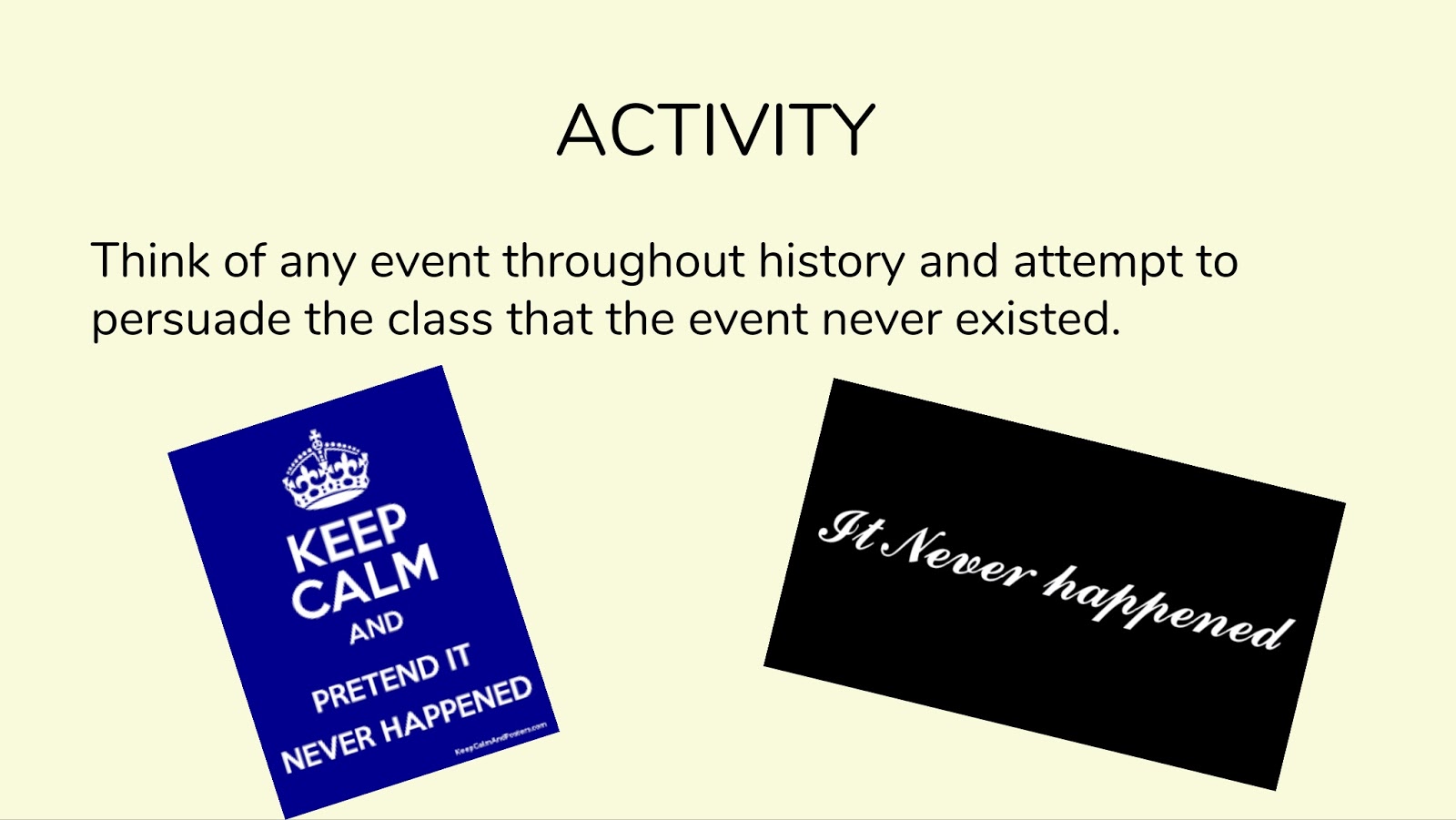
Group three went first as they had to finish their presentation. We did the activity which is pictured below

To answer this activity a member from group six used information and twisted it to try to convince the rest of the class that it never occurred. They took information and portrayed it in a completely different way to the class to try to make them believe. This activity shows how in 1984 the party uses very similar techniques to make the people believe what they want. They manipulate history and only allow certain things to be know to the public which allows them to control them more easily.
After this activity the group summarized what was discussed throughout the lesson and go on to say how the manipulation of history goes on in real life and that we have to be aware of this.
This is the link to the full presentation- https://docs.google.com/presentation/d/1Na4Q1RG73D2bJF62JjKty6unzrzkQWthfaotTukqaXw
After group three finished their presentation group five went on to present their lesson about physical control

For the do now we had a class discussion about whether or not someone did something again after they were punished for the same thing before. Based on the class discussion we came to the conclusion that depending of the severity of the action that was being punished most people would not do it again. In addition how the physical control of being punished allows for people to be more easily manipulated.
The definition of physical control is the ability to manipulate any movement of a person or control their every action. It can be done through the use of enforced activities or scare tactics. The purpose of physical control in 1984 is to enforce loyalty to the party. Some examples of this are the two minute, the physical jerks, the telescreens, and the ministry of love.

Punishment is used in controlling the people of Oceania by having them tortured for a couple of months or sometimes years. This causes for people to have fear towards having ideas that do not align with that of the party. The people of Oceania are tortured until they confess what they have done and love big brother. Winston’s behavior before being brought to the ministry of love is that of a rebel. He has many thoughts that are against the party but did not dare say them aloud. Meanwhile in the place he starts to confess to everything and begins to start thinking like the r est and begins to love big brother. He goes from thinking 2+2=4 to aligning with the party and thinking 2+2=5
Here is the link for the full presentation-
https://docs.google.com/presentation/d/11VV9zzfT8uQqiVUW8DQsLq1o28jwRSVO902jR9gOGo0
The final group to present was group five and their presentation was on technological manipulation.
 For the Do Now as a class we discussed the many ways we could use technology to manipulate the people and sway them to our side. A couple students said that we could use tracking devices on peoples phones as now in this day people always are on their phones. In addition to tracking them you could also use the cameras to look at people at all times and make sure they are following what you say. You could also use the microphone in order to share with people the information you wanted.
For the class activity we used https://www.nationstates.net/ to create our own nation to see what effects the limitations we set on peopl had on the nation as a whole. We were able to see as the more control we had over the people the less ideas they had and less rights.
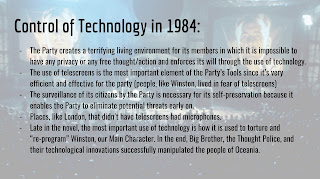
In this slide were able to see how technology was controlled in 1984 and what the effects were. Most people lived in fear and did not have privacy and the right to think of their own ideas. The telescreens were vital so the party could keep a close watch on the people and to make sure they were not having ideas that threatened their power. In the next two slides we were able to see how this relates to things that are happing in real life. For example how in china a lot things are blocked on the internet by the government to make sure people do not know information threy want to keep a secret. In addition china is developing new surveillance programs which could recognize people and the way they walk and through high level facial recognition software. We also saw how in the Soviet Union they controlled their people through propaganda distributed by radio, television, and posters.
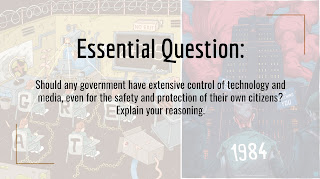
Many students argued that any government should not have extensive control of technology and media. This is due to the fact that everyone should have a right to their privacy and if people are monitored all the time they do not have this therefore they can not do as they please and have their own train of thought. If this is the case a society will never be able to change because the people will always do and think what the leaders want them to.
Here is the link for the full presentation-
https://docs.google.com/presentation/d/15P0A_XHLXrJ17Dt1MbYpzseTghxTNJrHyddl81ypues
Today we finished presenting our our 1984 lesson projects. Group three finished presenting their lesson about information and history manipulation. Then group four presented their lesson on physical control, and finally group five presented their lesson on technological manipulation.
Group three went first as they had to finish their presentation. We did the activity which is pictured below
After this activity the group summarized what was discussed throughout the lesson and go on to say how the manipulation of history goes on in real life and that we have to be aware of this.
This is the link to the full presentation- https://docs.google.com/presentation/d/1Na4Q1RG73D2bJF62JjKty6unzrzkQWthfaotTukqaXw
After group three finished their presentation group five went on to present their lesson about physical control

For the do now we had a class discussion about whether or not someone did something again after they were punished for the same thing before. Based on the class discussion we came to the conclusion that depending of the severity of the action that was being punished most people would not do it again. In addition how the physical control of being punished allows for people to be more easily manipulated.
The definition of physical control is the ability to manipulate any movement of a person or control their every action. It can be done through the use of enforced activities or scare tactics. The purpose of physical control in 1984 is to enforce loyalty to the party. Some examples of this are the two minute, the physical jerks, the telescreens, and the ministry of love.

Punishment is used in controlling the people of Oceania by having them tortured for a couple of months or sometimes years. This causes for people to have fear towards having ideas that do not align with that of the party. The people of Oceania are tortured until they confess what they have done and love big brother. Winston’s behavior before being brought to the ministry of love is that of a rebel. He has many thoughts that are against the party but did not dare say them aloud. Meanwhile in the place he starts to confess to everything and begins to start thinking like the r est and begins to love big brother. He goes from thinking 2+2=4 to aligning with the party and thinking 2+2=5
Here is the link for the full presentation-
https://docs.google.com/presentation/d/11VV9zzfT8uQqiVUW8DQsLq1o28jwRSVO902jR9gOGo0
The final group to present was group five and their presentation was on technological manipulation.

For the class activity we used https://www.nationstates.net/ to create our own nation to see what effects the limitations we set on peopl had on the nation as a whole. We were able to see as the more control we had over the people the less ideas they had and less rights.
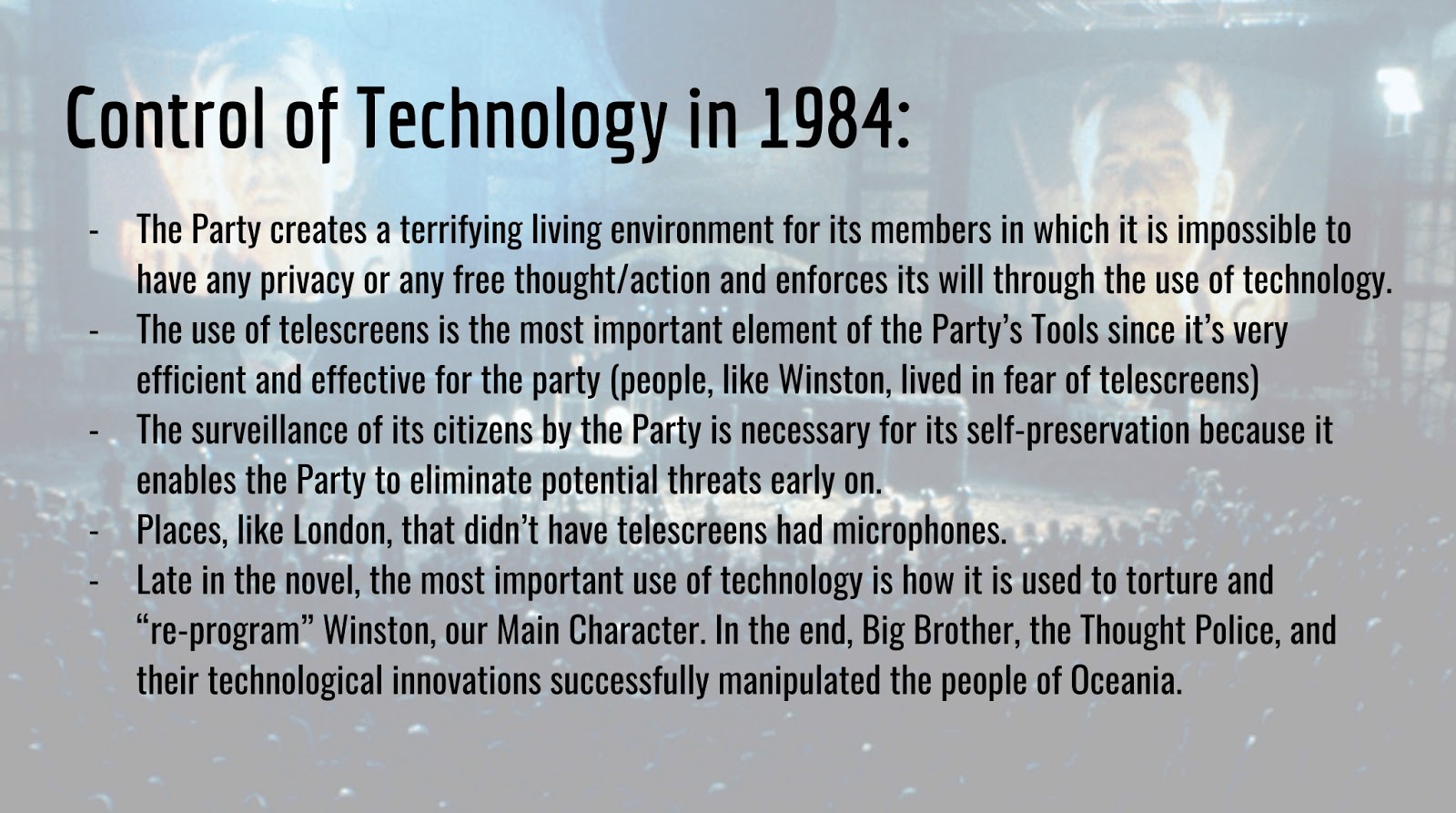
In this slide were able to see how technology was controlled in 1984 and what the effects were. Most people lived in fear and did not have privacy and the right to think of their own ideas. The telescreens were vital so the party could keep a close watch on the people and to make sure they were not having ideas that threatened their power. In the next two slides we were able to see how this relates to things that are happing in real life. For example how in china a lot things are blocked on the internet by the government to make sure people do not know information threy want to keep a secret. In addition china is developing new surveillance programs which could recognize people and the way they walk and through high level facial recognition software. We also saw how in the Soviet Union they controlled their people through propaganda distributed by radio, television, and posters.

Many students argued that any government should not have extensive control of technology and media. This is due to the fact that everyone should have a right to their privacy and if people are monitored all the time they do not have this therefore they can not do as they please and have their own train of thought. If this is the case a society will never be able to change because the people will always do and think what the leaders want them to.
Here is the link for the full presentation-
https://docs.google.com/presentation/d/15P0A_XHLXrJ17Dt1MbYpzseTghxTNJrHyddl81ypues
Wednesday, April 17, 2019
Kailey Christensen, #7-6, 4/17/19
4/17/19
Today we continued our 1984 lesson presentations from yesterday. Group 6 finished their presentation on Psychological Manipulation, Group 1 did their presentation on Political Control (totalitarianism), and Group 3 started their presentation on Information and History Manipulation.
My group did Political Control and this was our presentation
https://docs.google.com/presentation/d/19OmwAFDXdgGDzbOR8hxZoCghTr-aqKhCE4MWticXoBU
Group 6: Psychological Manipulation


Group 3: Information and History Manipulation
 For the Do Now, groups were given different topics to research and discuss with the class what they found
Groups 1 and 2 said that the Soviet Union censored many books and classic literature because t did not agree with the Party’s ideas, the people of the Soviet Union were not allowed to read these books
Groups 4 and 5 said that Tiananmen Square was a good example of Chinese manipulation because the government rewrote what actually happened in Tiananmen Square. The government also banned many websites and most popular search engines like Google and Yahoo.
Group 6 said that St Valentine was the god of fertility and many nations used to perform sacrifices to him and there were many rituals in which women seeking fertility were beaten.
 Group 3 discussed how in the Soviet Union, Joseph Stalin would physically remove people from photographs that he killed to make it seem as if they never existed in the first place. This was very similar to how the Party vaporized citizen that they felt were a threat to the Party, just as Stalin felt these people were a threat to his rule.
Today we continued our 1984 lesson presentations from yesterday. Group 6 finished their presentation on Psychological Manipulation, Group 1 did their presentation on Political Control (totalitarianism), and Group 3 started their presentation on Information and History Manipulation.
My group did Political Control and this was our presentation
https://docs.google.com/presentation/d/19OmwAFDXdgGDzbOR8hxZoCghTr-aqKhCE4MWticXoBU
Group 6: Psychological Manipulation

My group discussed that the Party takes advantage of the Oceania citizens’ minds by using doublethink and crimestop to condition the people’s minds into thinking that whatever the Party thinks is the best and also to stop them from even thinking about conspiring against the Party. They also manipulate the people’s memories to the point where they dont even remember what actually happened or not.

Most people argued that our government should not use psychological control to make society a better place because then we wouldn’t be able to question the world or the government around us. However, people did think that it could be successful because people’s memories are easily manipulated. Another point was brought up that we could not define what made society a better place because each person would have a different viewpoint.

For the summary, we discussed the overall meaning of psychological manipulation and how it aids the Party in being so successful. They related their do now experiment back to 1984 and their use of psychological manipulation as well.

Groups 1 and 2 said that the Soviet Union censored many books and classic literature because t did not agree with the Party’s ideas, the people of the Soviet Union were not allowed to read these books
Groups 4 and 5 said that Tiananmen Square was a good example of Chinese manipulation because the government rewrote what actually happened in Tiananmen Square. The government also banned many websites and most popular search engines like Google and Yahoo.
Group 6 said that St Valentine was the god of fertility and many nations used to perform sacrifices to him and there were many rituals in which women seeking fertility were beaten.

Thursday, April 11, 2019
Blogger #7-3 George Baslous 4/11/19
Aim: How can we appreciate the range of influence 1984 has in culture and awareness?
Do Now:
A. Any questions about the reading?
B. Read the article "No One Died in Tiananmen Square" by William Lutz
1. Annotate as you read
2. Do you notice any rhetorical techniques?
3. Reflect on the meaning of the article. What are your thoughts?
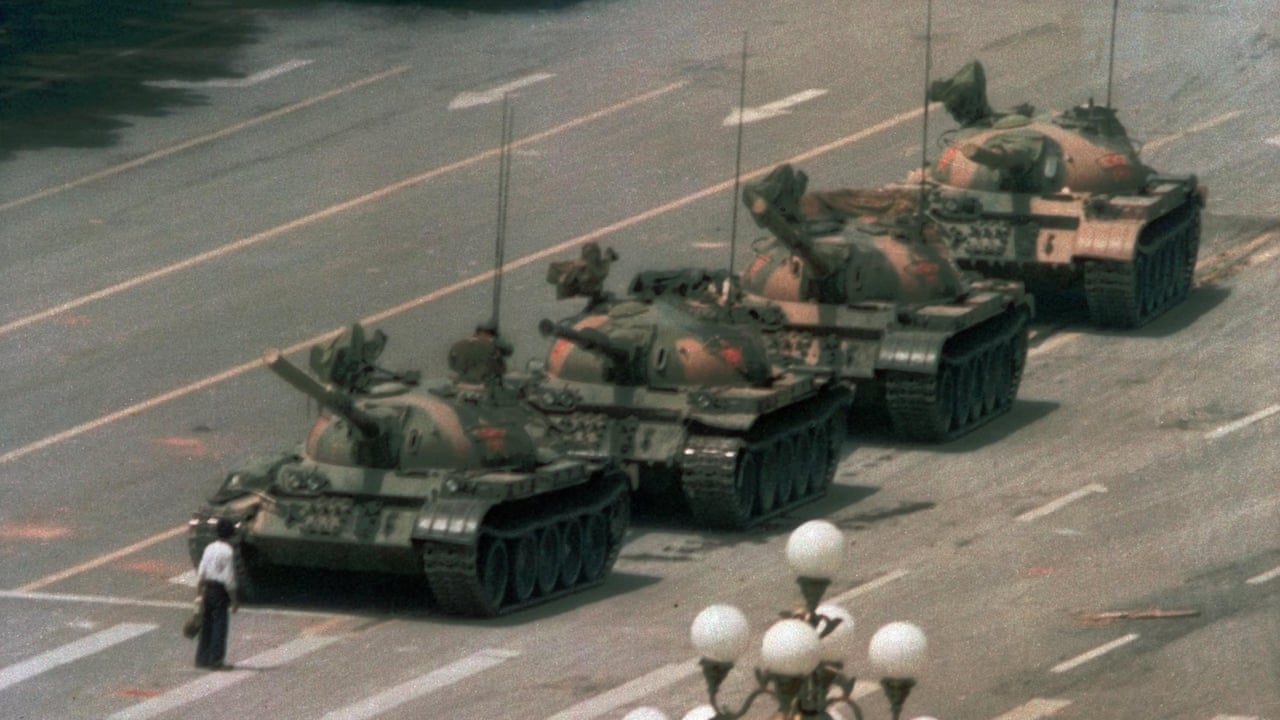
After we read "No One Died in Tiananmen Square," by William Lutz, we discussed our thoughts within our groups and then opened it up to a full class discussion. The history behind this massacre was that there was a protest led by students after Deng Xiaoping came to power in an attempt to gain more rights in a Communist-led government. The article (https://drive.google.com/file/d/1jvRGiG17oZi9JOlxoNHH017tF-2J-h6B/view) spoke about the denial of the existence of the Tiananmen Massacre that occurred in Beijing even though most people know that the occurrence of the massacre was a reality, as pictured below:

Do Now:
A. Any questions about the reading?
B. Read the article "No One Died in Tiananmen Square" by William Lutz
1. Annotate as you read
2. Do you notice any rhetorical techniques?
3. Reflect on the meaning of the article. What are your thoughts?
After we read "No One Died in Tiananmen Square," by William Lutz, we discussed our thoughts within our groups and then opened it up to a full class discussion. The history behind this massacre was that there was a protest led by students after Deng Xiaoping came to power in an attempt to gain more rights in a Communist-led government. The article (https://drive.google.com/file/d/1jvRGiG17oZi9JOlxoNHH017tF-2J-h6B/view) spoke about the denial of the existence of the Tiananmen Massacre that occurred in Beijing even though most people know that the occurrence of the massacre was a reality, as pictured below:
We discussed how William Lutz uses rhetorical devices such as repetition in which he keeps reiterating phrases such as, "No one died," and "No students were shot." Similarly, in 1984 the Inner Party manipulates the citizens of Oceania by saying false facts such as who Oceania is at war with to establish their absolute power. Through the power of literature, it becomes easy to influence opinions.
Afterwards, we had a debate about 'Does history exist if there is no one to remember it?' One of the arguments made was as follows
- Even if nobody knows what happened 3000 years ago, it still happened and should be acknowledged. Before Mount Everest was discovered, what was the tallest mountain? Still Mount Everest, but nobody knew yet. Likewise, with history, the past will be uncovered sooner or later by archaeologists, so it technically still exists.
By the end of the debate, we didn't come to a conclusion to the question at hand, but the debate helped us understand how easy history is changed in 1984. By keeping knowledge of history within the Party, everyone of Oceania is naive and oblivious to what is happening around them. This make it easy for the Party to continuously change history because nobody is wise enough to know what actually happened.
Tuesday, April 9, 2019
Agustin Ballinas Blogger #2 04/08/19
Aim: How does Orwell's use of beauty in language at the Ministry of Love contribute to the meaning of the work as a whole?
Do Now: We all have a favorite quote. Whether its a line from a novel, play, newspaper, song, etc., we have words which resonate with our very soul. What is yours? Write it on the Padlet!
At the beginning of the class we were given a QR code/a link to a website called PADLET and we were tasked with uploading our favorite quotes so that the whole class could see them.

Here are some examples of the quotes that people posted on the Padlet. There were quotes from different sources, a majority came from famous people and pop culture, there were also a couple from famous books.
 After everyone had read through the quotes we started a group activity, we read through Part 3 Chapter 2 of 1984 by George Orwell and we chose a paragraph that we found to be beautifully ironic, we then wrote about why we thought it was ironic. I chose "‘But how can you stop people remembering things?’ cried
Winston again momentarily forgetting the dial. ‘It is involuntary. It is outside oneself. How can you control memory?
You have not controlled mine!’
O’Brien’s manner grew stern again. He laid his hand on
the dial.
‘On the contrary,’ he said, ‘YOU have not controlled it. " because I thought it was ironic that O'Brien was telling Winston that he had no control over his own memory when in reality Winston is able to remember things from the past and question the Party while O'Brien was just following the Party blindly. I think this activity was useful because it made us analyze the characters in 1984 and how Winston and O'Brien have two different definitions for the word control.
After everyone had read through the quotes we started a group activity, we read through Part 3 Chapter 2 of 1984 by George Orwell and we chose a paragraph that we found to be beautifully ironic, we then wrote about why we thought it was ironic. I chose "‘But how can you stop people remembering things?’ cried
Winston again momentarily forgetting the dial. ‘It is involuntary. It is outside oneself. How can you control memory?
You have not controlled mine!’
O’Brien’s manner grew stern again. He laid his hand on
the dial.
‘On the contrary,’ he said, ‘YOU have not controlled it. " because I thought it was ironic that O'Brien was telling Winston that he had no control over his own memory when in reality Winston is able to remember things from the past and question the Party while O'Brien was just following the Party blindly. I think this activity was useful because it made us analyze the characters in 1984 and how Winston and O'Brien have two different definitions for the word control.
Do Now: We all have a favorite quote. Whether its a line from a novel, play, newspaper, song, etc., we have words which resonate with our very soul. What is yours? Write it on the Padlet!
At the beginning of the class we were given a QR code/a link to a website called PADLET and we were tasked with uploading our favorite quotes so that the whole class could see them.

Here are some examples of the quotes that people posted on the Padlet. There were quotes from different sources, a majority came from famous people and pop culture, there were also a couple from famous books.

Tuesday, December 18, 2018
Agustin Ballinas, Blogger #2, 12/18/18
Aim: How does Shakespeare's use of complex character development illuminate central themes and contribute to Macbeth as a whole?
"Cluster Activity (Part 1) Exploring Ms. Fusaro's wallet... What can you determine about my character from the items you find in my wallet?"
 Today in class, Ms. Fusaro allowed us to go through her wallet to see how much we could find out about a person just by seeing the contents of their wallets. She entrusted her wallet to a fellow student, George, and as he went through the wallet he would announce to the class whatever he found. As we went through Ms. Fusaro's
wallet we found out stuff about her that we didn't previously know about her, such as that she is a blood donor. She also has several forms of writing utensils in her purse as well as several different methods of payment and this shows that she is prepared for different occasions. We could use this skill in real life to find out more about a person that we have been originally not given much information about.
 "Cluster Activity (Part 2) Character Wallets-Each group must choose a character (in Macbeth) and create a wallet with contents that are suitable for that character at this point in the play..."
After going through Ms. Fusaro's wallet we were tasked with creating a wallet of a character in Macbeth and the purpose of doing this was to force us to think about what each character would have in their wallet and this would help us to identify how each character was unique.
"Cluster Activity (Part 1) Exploring Ms. Fusaro's wallet... What can you determine about my character from the items you find in my wallet?"
 |
 Today in class, Ms. Fusaro allowed us to go through her wallet to see how much we could find out about a person just by seeing the contents of their wallets. She entrusted her wallet to a fellow student, George, and as he went through the wallet he would announce to the class whatever he found. As we went through Ms. Fusaro's
wallet we found out stuff about her that we didn't previously know about her, such as that she is a blood donor. She also has several forms of writing utensils in her purse as well as several different methods of payment and this shows that she is prepared for different occasions. We could use this skill in real life to find out more about a person that we have been originally not given much information about.
 "Cluster Activity (Part 2) Character Wallets-Each group must choose a character (in Macbeth) and create a wallet with contents that are suitable for that character at this point in the play..."
After going through Ms. Fusaro's wallet we were tasked with creating a wallet of a character in Macbeth and the purpose of doing this was to force us to think about what each character would have in their wallet and this would help us to identify how each character was unique.
Monday, November 5, 2018
How do Macbeth’s Motivation compare to his interaction with different characters?
Kelly Lin
November 5, 2018
Mrs. Fusaro-Pizzo, Blogger #20
Sophomores, Period 7
Aim: How does Macbeth's multiple or conflicting motivation compare to his interaction with other character advance the plot or develop the theme?
Brief class activity
In class, we continue to to read Macbeth Act I Scene III and IV with the same student, cast, from the previous blog, bravely and fluently reading out loud in front of the class again.
We then proceed to analyze the wisdom Banquo portrayed during his discussion with Macbeth after their first interaction with the Witches and their 'prophecy'. He conclude that the Witches might only had given them the truth in order to win their trust and later betray them when they are unguarded against them. From this we conclude that Banquo is a smart and attentive character that is able to see a bigger picture judging by the way he interpreted the reasons the Witches might have presented them with honest truth, the prophecy.
Afterward, we then started to focus more on the change in Macbeth and his 'aside' throughout the play. Paying more attention to who he is directing his speech at and with. For example, his soliloquy and aside with Banquo.
Group Work
1. What does the figurative language used by Banquo in the line “instruments of darkness” imply?
- This figurative languages used by Banquo shows the way he views the Witches with suspicion and by labeling them as "instrument of darkness" he is also implying that they might bring huge calamity or destruction or some extremely huge conspiracies.
2. What is Banquo’s warning to Macbeth in lines 132-139?
- The presence of the Witch itself is suspicious and the fact that they are presenting them, Macbeth and Banquo, with honest fact and truth puts them, Witches, in even more suspicion. He is warning that are trying to gain their trust by presenting the truth but then will betray them later on resulting them facing huge consequences when they are unguarded against them in their most vulnerable state.
By the end of class, and brief analysis on Macbeth soliloquy, we realized that Macbeth is starting to change from a loyal soldier that defends his homeland, and kills his enemies, to someone with great ambition to become a king after he's interaction with the Witches and the 'prophecy'.
Friday, November 2, 2018
“Fair is Foul, Foul is Fair”
Kelly Lin
November 2, 2018
Mrs. Fusaro-Pizzo, Blogger #20Sophomores, Period 7
Aim: How does Macbeth’s multiple or conflicting motivations compared with his interaction with other characters advance the plot or develop the theme?
DONOW: Pair Share
What conclusion did you draw about “Fair is Foul, Foul is Fair” from Your Big Paper/Little Paer discussion?
In class, students volunteered to read out loud Act 1, scene 2, bravely standing in front of the entire class and projecting their voice loud and clear.

November 2, 2018
Mrs. Fusaro-Pizzo, Blogger #20Sophomores, Period 7
Aim: How does Macbeth’s multiple or conflicting motivations compared with his interaction with other characters advance the plot or develop the theme?
DONOW: Pair Share
What conclusion did you draw about “Fair is Foul, Foul is Fair” from Your Big Paper/Little Paer discussion?
In class, students volunteered to read out loud Act 1, scene 2, bravely standing in front of the entire class and projecting their voice loud and clear.

As we are reading, we realize the three Witches could change and manipulate nature but they can not killed a man himself with their magic. Connecting it with Greek mythology, we see that Shakespeare was probably inspire by Goddess, for example Demeter, of nature, which is why the Witches power is only limited to nature.
Aside can be soliloquy but soliloquy.
Aside- thinking out loud or conversation with other that is heard by the audience but not meant for other character to hear
Tuesday, September 25, 2018
Blog #3, George Baslous, Blogger #7-3
September 25,2018
Mrs. Fusaro-Pizzo, Blogger #7-3
Sophomores, Period 7
Do Now: Discuss and record your thoughts, questions, and enlightenment about Chapter 1 of "Lord of the Flies." Be prepared to share with the class.
During today's class period, we talked within our teams about questions or thoughts we had after reading chapter 1 of "Lord of the Flies." Each of our groups recorded what we discussed, and then people from each team shared their ideas with the rest of the class. Here are some of the TQE's from today's discussion:

By sharing our thoughts and ideas about the book, we were able to build off of each other and further the discussion. We spoke about how the boys in the book were acting mature and responsible by themselves on the island, despite their young age, and we also spoke about how well William Golding used characterization and dialogue to develop his characters.
Blog #2, Agustin Ballinas, Blogger #7-2
September 24, 2018
Mrs. Fusaro-Pizzo, Blogger #7-2
Sophomores, Period 7
Mrs. Fusaro-Pizzo, Blogger #7-2
Sophomores, Period 7
Aim: Presenting Fahrenheit 451 Newspaper projects.
Do Now: Fill in the Newspaper projects rubric sheet and get ready to present with your group.


The Happy News (On the left) is the first group to present and their Newspaper has a main article about the protagonist of the story Guy Montag as well as a side advertisement about toothpaste and this is a reference to something that happened in Fahrenheit 451. The following presentations followed a similar pattern of having a main article that was a major event in the story and having advertisements that included details or objects from the plot.
After each presentation the newspapers were passed around and we saw each of the newspapers and we saw the details that we couldn't see when they were being presented. This project helped us by making us envision the story and forcing us to try and report the events of the book as if they were actually occurring. In the last few minutes of class, group members were talking with one another about the presentations and some groups were sighing with relief that they didn't have to present today.

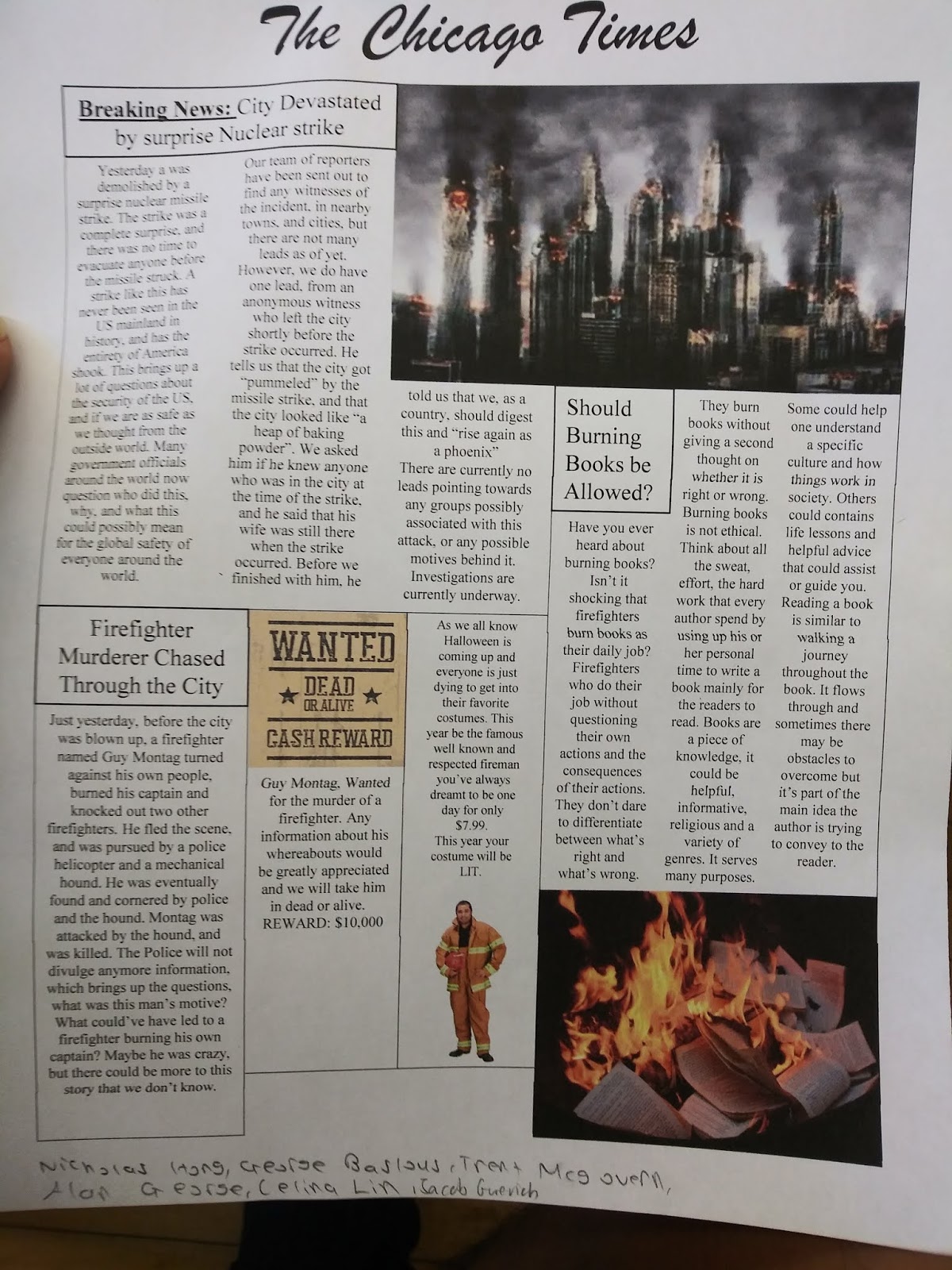
The Happy News (On the left) is the first group to present and their Newspaper has a main article about the protagonist of the story Guy Montag as well as a side advertisement about toothpaste and this is a reference to something that happened in Fahrenheit 451. The following presentations followed a similar pattern of having a main article that was a major event in the story and having advertisements that included details or objects from the plot.
After each presentation the newspapers were passed around and we saw each of the newspapers and we saw the details that we couldn't see when they were being presented. This project helped us by making us envision the story and forcing us to try and report the events of the book as if they were actually occurring. In the last few minutes of class, group members were talking with one another about the presentations and some groups were sighing with relief that they didn't have to present today.
Subscribe to:
Posts (Atom)