9/23/19
Jayden Huang
Period 5
Aim: How does close reading of “Lord of the Flies” demonstrate the power naming has in society?
Today, we had discussed the importance and the power a name has. We began the lesson with a do now, asking us about the history of our first name, why our parents chose it, if it defines us, and if it adds to our character. After a short period to brainstorm, we discussed and shared our answers to the class. A variety of different stories and different opinions were shared. We overall came to a conclusion that while your name can show things about you like your culture or heritage, you would still be the same person even if you had a different name, like the Romeo and Juliet quote “What’s in a name? That which we call a rose by any other name would smell as sweet.”
Afterwards, we began to discuss the importance of naming in “The Lord of the Flies.” We first began by discussing with our teams about each chapter title, and what we thought they might mean. We inferred, that based on our knowledge of chapter 1, that each title might describe an important event in the chapter, like in chapter 1,“The Sound of a Shell,” the conch shell being the important event of the chapter. We also thought that some of the chapter titles seemed to have negative connotations and seemed grim, like “Beast from Water” and “A View to a Death.”
After this, we began to focus on a specific section of the chapter, where Ralph and the fat boy, as the story calls him, have a discussion about getting to know all the boys’ names, and when Ralph finds out about the fat boy’s nickname, Piggy. In this situation, we are able to learn a lot about Piggy as a character. For example, through this quote we were able to infer that Piggy just wanted to be recognized, and even though he hated the name Piggy, he still enjoyed receiving recognition. This can be seen in the quote “Piggy grinned reluctantly, pleased despite himself at even this much recognition.” Another idea we had about Piggy was how he was a leader, but one behind the scenes. This was seen when Piggy was on the sidelines, helping Ralph to blow the conch shell, gathering all the boys, and relaying to Ralph the names of each boy.
Overall, what I personally learned during this lesson was the power that the name of something can have. Initially, as a class we believed that a different name didn’t change someone, but after discussion about titles in “The Lord of the Flies,” we realized that names do have a lot of power, and that they can show a lot about what it is naming. We learned this because everything in our world has a name, so knowing the power of names helps us to better understand the world around us. Personally, I will use the information learned today to be able to better understand choices in names, specifically in literature, and the reasons the author might have had in choosing such a name.
Monday, September 23, 2019

9/20/19 Wayne Koh PD1
9/20/2019
Modern Mythology 2020
Wayne Koh
PD1
In today's mythology class, we had to present our summer reading projects
based on the book we read over the summer: The Road by Cormac McCarthy. We were
tasked to explain what happened prior to the beginning of the novel and what drove the
humans to make the choices they did in the book along with creating a book cover and
title depicting it.
Subsections are the group’s chosen title for their book.
The Great Death
The presentation began by suggesting the possibility of a supervolcanic eruption
leading to The Road. They deem this possible because the dust from the meteor would
have ended the majority of life on Earth as we know of it. The group continued to
provide scientific evidence to support this claim. The group then went over the cover
which depicted a volcano over green grass and grey smoke covering the entire page.
The entire cover was done on a black construction paper. They explained that the dark
background was reminiscent to the overall theme of the book. Additionally, they added a
subtle detail of a skull onto the smoke, as a skull is a universal symbol of death and
death being a very theme that is brought up very often in the book. In the cover, only the
lava and the grass have color. One of the members explained that the lava can be
thought of as fire, which is a symbol for hope and the love between the man and his
son. The color of both the fire and the grass contrasts the desolate and bland world that
the man and the boy both live in.
Overall, I liked how the details this group used but if some more visuals used in
the presentation would have strengthened it. There was little mention of how the
humans have worsened their situation.
The Last War
In my own group’s presentation, we believed that Earth was once a utopian
society, with the cure to cancer being found and world hunger and disease almost
eradicated. However, a meteor struck Earth and in a scramble to fight over resources,
the world’s leaders decided to go to war, despite the lack of resources left. Many fought
over essential resources, such as clean water and food, and were willing to use extreme
measures to put themselves at an advantage. As the humans began eradicating
themselves, few survived. One of the major reasons for the downfall of humanity was greed. People would either greed over resources, refuse to share and die before being
able to use said resources (“Crate upon crate of canned goods. Tomatoes, peaches,
beans, apricots. Canned hams. Corned beef. Hundreds of gallons of water in ten gallon
plastic jerry jugs. Paper towels, toiletpaper, paper plates. Plastic trash bags stuffed with
blankets.”). Additionally, as major food sources were depleted, people began to
desperately find anything to eat. For some, this included children, as they were seen to
be too weak to fight back. However, the youth are a symbol of hope and belief in the
future. By eating the youth, the people have given up hope and their belief of the future
becoming better. Our book cover had a mushroom cloud with, with bomber planes in
the air destroying nearby buildings. Bystanders can be seen pointing at it all, expressing
their confusion. The man and the boys mother, clearly pregnant, are on the front of the
cover, embracing each other. The title, “The Last War”, can be seen splattered in the
middle of the cover. A grey body of water shows the unsanitary water from the dust
stirred up by the meteor.
One of our strongest points was our cover, as it depicts our vision of the moment
that ended the pre-apocalyptic world. However, one of the things we lacked was the
inclusion of more detail of the pre-apocalyptic world. Another level of depth would have
made the presentation stronger.
1:17
In this presentation, they believed that the prequel would have a more biblical
basis. They said that since McCarthy was more religious in the later stages of his life,
he might have intended The Road to be interpreted more as such too. In one of the
quotes the groups used, “The clocks stopped at 1:17. A long shear of light and then a
series of low concussions”, they thought that the time had more significance. They
made a connection between the time and a Bible verse, specifically to Revelation 1:17.
The verse states “When I saw him, I fell at his feet as though dead. But he laid his right
hand on me, saying, ‘Fear not, I am the first and the last’.” This is similar to one of the
lines the boy has, “Yes I am, he said. I am the one”, which further proves him to be a
Christ figure. As for what took place before the apocalyptic world of The Road, the
group brought up a biblical story of the Seven Eyed Lamb. To summarize, God was not
happy with humanity and sent Jesus down as a seven eyed lamb. As the seven seals
were broken, the following events took place: The Four Horsemen of the Apocalypse
(Pestilence, War, Famine, and Death) being released, the martyrs crying out, celestial
signs, and the Heavens being silent. The seven seals being broken may have caused
meteors, earthquakes, leveling of the mountains, blackening of the sky, along with the
Four Horsemen. In their cover, they drew a demolished road with the boy being shown
at the beginning of the road, showing how he still has much of his journey left.In my opinion, this group’s idea was one of the more interesting ones, as it dealt
with the more religious side of McCarthy. One of the things they could have done better
was the inclusion of more details from the slide into the cover itself. Otherwise, I think
this presentation was solid.
The Strike
This group also believed that a meteor struck Earth and caused many natural
disasters, such as tsunami and earthquakes, to destroy the world. One thing that made
this group stand out was their focus on the role of government. As the meteor struck
Earth, communities were formed out of panic and for mutual reassurance. In a State of
Emergency, the government can declare martial law, which would replace the local
officers with national guards and places the huge regions under the control of the
military body. Additionally, under the International Emergency Economic Powers Act
(1977), the government is allowed to freeze assets and block financial transactions. The
group corroborate their vision by including details of utilities shutting down and
barricades being put up. This group also puts the blame on human greed and their
desperation to stay alive. As a result, this eliminates trust in this world with one of the
only exceptions being the boy. The man does not care for anything except for the
survival of his son. On the cover, a sunny sky and grey sky are divided and a meteor
strike can be seen from the grey side. The sunny side includes a happy couple, a big
and colorful home, and a pond with a turtle on the side. On the grey side, the buildings
are monotonous and colorless, most of them broken. A dead tree can be seen next to a
man in rags. The sunny side represents life before the meteor strike and the happiness
and prosperity. The grey side represents life in the apocalyptic world. The man in the
rags represents the situation the people are in, having to move constantly and a lower
standard of cleanliness, as it is not the top priority. The dead tree and the destroyed
houses emphasize both the lack of life and how people were forced to abandon their
previous lifestyles in order to survive in this world.
This group’s cover included many symbols that conveyed their vision quite well.
The focus on the role of the people/government was an interesting take on this task too.
Overall, I think this was one of the better presentations in the class.
Reflection
This project was an interesting experience and was a great exercise for
creativity. As McCarthy never revealed what really happened prior to The Road, every
group’s vision was not wrong, as long as they provided evidence that made it plausible.
I thought that 1:17 had an interesting concept of the events that happened prior to the
book, bringing McCarthy’s religious strong religious beliefs into consideration. The
Strike’s idea of the government practicing martial law and the cover art was unique and made the presentation fun to listen on. The Great Death had a good use of symbolism
in their cover and was able to convey it well. I thought that our group had an explanation
as to why and how the meteor and the “World War” translated into The Road. I enjoyed
this creative and freethinking project and I would like to keep this freedom throughout all
the work we do in Modern Mythology.
Modern Mythology 2020
Wayne Koh
PD1
In today's mythology class, we had to present our summer reading projects
based on the book we read over the summer: The Road by Cormac McCarthy. We were
tasked to explain what happened prior to the beginning of the novel and what drove the
humans to make the choices they did in the book along with creating a book cover and
title depicting it.
Subsections are the group’s chosen title for their book.
The Great Death
The presentation began by suggesting the possibility of a supervolcanic eruption
leading to The Road. They deem this possible because the dust from the meteor would
have ended the majority of life on Earth as we know of it. The group continued to
provide scientific evidence to support this claim. The group then went over the cover
which depicted a volcano over green grass and grey smoke covering the entire page.
The entire cover was done on a black construction paper. They explained that the dark
background was reminiscent to the overall theme of the book. Additionally, they added a
subtle detail of a skull onto the smoke, as a skull is a universal symbol of death and
death being a very theme that is brought up very often in the book. In the cover, only the
lava and the grass have color. One of the members explained that the lava can be
thought of as fire, which is a symbol for hope and the love between the man and his
son. The color of both the fire and the grass contrasts the desolate and bland world that
the man and the boy both live in.
Overall, I liked how the details this group used but if some more visuals used in
the presentation would have strengthened it. There was little mention of how the
humans have worsened their situation.
The Last War
In my own group’s presentation, we believed that Earth was once a utopian
society, with the cure to cancer being found and world hunger and disease almost
eradicated. However, a meteor struck Earth and in a scramble to fight over resources,
the world’s leaders decided to go to war, despite the lack of resources left. Many fought
over essential resources, such as clean water and food, and were willing to use extreme
measures to put themselves at an advantage. As the humans began eradicating
themselves, few survived. One of the major reasons for the downfall of humanity was greed. People would either greed over resources, refuse to share and die before being
able to use said resources (“Crate upon crate of canned goods. Tomatoes, peaches,
beans, apricots. Canned hams. Corned beef. Hundreds of gallons of water in ten gallon
plastic jerry jugs. Paper towels, toiletpaper, paper plates. Plastic trash bags stuffed with
blankets.”). Additionally, as major food sources were depleted, people began to
desperately find anything to eat. For some, this included children, as they were seen to
be too weak to fight back. However, the youth are a symbol of hope and belief in the
future. By eating the youth, the people have given up hope and their belief of the future
becoming better. Our book cover had a mushroom cloud with, with bomber planes in
the air destroying nearby buildings. Bystanders can be seen pointing at it all, expressing
their confusion. The man and the boys mother, clearly pregnant, are on the front of the
cover, embracing each other. The title, “The Last War”, can be seen splattered in the
middle of the cover. A grey body of water shows the unsanitary water from the dust
stirred up by the meteor.
One of our strongest points was our cover, as it depicts our vision of the moment
that ended the pre-apocalyptic world. However, one of the things we lacked was the
inclusion of more detail of the pre-apocalyptic world. Another level of depth would have
made the presentation stronger.
1:17
In this presentation, they believed that the prequel would have a more biblical
basis. They said that since McCarthy was more religious in the later stages of his life,
he might have intended The Road to be interpreted more as such too. In one of the
quotes the groups used, “The clocks stopped at 1:17. A long shear of light and then a
series of low concussions”, they thought that the time had more significance. They
made a connection between the time and a Bible verse, specifically to Revelation 1:17.
The verse states “When I saw him, I fell at his feet as though dead. But he laid his right
hand on me, saying, ‘Fear not, I am the first and the last’.” This is similar to one of the
lines the boy has, “Yes I am, he said. I am the one”, which further proves him to be a
Christ figure. As for what took place before the apocalyptic world of The Road, the
group brought up a biblical story of the Seven Eyed Lamb. To summarize, God was not
happy with humanity and sent Jesus down as a seven eyed lamb. As the seven seals
were broken, the following events took place: The Four Horsemen of the Apocalypse
(Pestilence, War, Famine, and Death) being released, the martyrs crying out, celestial
signs, and the Heavens being silent. The seven seals being broken may have caused
meteors, earthquakes, leveling of the mountains, blackening of the sky, along with the
Four Horsemen. In their cover, they drew a demolished road with the boy being shown
at the beginning of the road, showing how he still has much of his journey left.In my opinion, this group’s idea was one of the more interesting ones, as it dealt
with the more religious side of McCarthy. One of the things they could have done better
was the inclusion of more details from the slide into the cover itself. Otherwise, I think
this presentation was solid.
The Strike
This group also believed that a meteor struck Earth and caused many natural
disasters, such as tsunami and earthquakes, to destroy the world. One thing that made
this group stand out was their focus on the role of government. As the meteor struck
Earth, communities were formed out of panic and for mutual reassurance. In a State of
Emergency, the government can declare martial law, which would replace the local
officers with national guards and places the huge regions under the control of the
military body. Additionally, under the International Emergency Economic Powers Act
(1977), the government is allowed to freeze assets and block financial transactions. The
group corroborate their vision by including details of utilities shutting down and
barricades being put up. This group also puts the blame on human greed and their
desperation to stay alive. As a result, this eliminates trust in this world with one of the
only exceptions being the boy. The man does not care for anything except for the
survival of his son. On the cover, a sunny sky and grey sky are divided and a meteor
strike can be seen from the grey side. The sunny side includes a happy couple, a big
and colorful home, and a pond with a turtle on the side. On the grey side, the buildings
are monotonous and colorless, most of them broken. A dead tree can be seen next to a
man in rags. The sunny side represents life before the meteor strike and the happiness
and prosperity. The grey side represents life in the apocalyptic world. The man in the
rags represents the situation the people are in, having to move constantly and a lower
standard of cleanliness, as it is not the top priority. The dead tree and the destroyed
houses emphasize both the lack of life and how people were forced to abandon their
previous lifestyles in order to survive in this world.
This group’s cover included many symbols that conveyed their vision quite well.
The focus on the role of the people/government was an interesting take on this task too.
Overall, I think this was one of the better presentations in the class.
Reflection
This project was an interesting experience and was a great exercise for
creativity. As McCarthy never revealed what really happened prior to The Road, every
group’s vision was not wrong, as long as they provided evidence that made it plausible.
I thought that 1:17 had an interesting concept of the events that happened prior to the
book, bringing McCarthy’s religious strong religious beliefs into consideration. The
Strike’s idea of the government practicing martial law and the cover art was unique and made the presentation fun to listen on. The Great Death had a good use of symbolism
in their cover and was able to convey it well. I thought that our group had an explanation
as to why and how the meteor and the “World War” translated into The Road. I enjoyed
this creative and freethinking project and I would like to keep this freedom throughout all
the work we do in Modern Mythology.
Sunday, September 22, 2019
9/20/19
Mark Gerges
Period 5: Sophomores
Aim: Take notes and reflect on the remainder of the Fahrenheit 451 Prequels using glow and grow
On Friday, we continued to present our Summer Reading Projects to the class. The project was to design a book cover that would be a prequel to Fahrenheit 451. In the presentations each group presented their cover and explained its components with a slideshow.
The first group, group 4, named their prequel “Fahrenheit 450…” . They chose this name because the group felt that since Fahrenheit 451 was the temperature point in which paper burned, Fahrenheit 450… could mean that it was just before all the chaos erupted and before the paper burned. Their cover consisted of a woman watching television from her home with a window to the outside, showing the large unquenchable fire. The television represents the dominance it has had over the people, the window shows the separation of two worlds: the government and the civilians, and the woman represents the people objecting of the governments idea.
The next group, group 6, named their prequel “Watching it Burn”. This was because the civilians of the city were literally watching their city “burn” and fall apart into ruin and chaos. Books were burned people were becoming less educated due to the government’s laws. Their cover consisted of unique people watching television. This represented how uniform the society was and how everything was set by the government. The cover also represents how everyone wanted to give into an easier life, later finding out that this would be their demise.
Lastly group 2 presented. I was amazed by group 2’s cover which was centered with a government official who had a television for a head which was to represent the objectiveness of the government and how the government took control over everyone with the television. It also showed how they used television to brainwash the people into what they wanted the people to believe. I felt that this combination hit the goal of the project directly on point and was exactly what was needed.
9/20/19 Michelle Kang Period 8
9/20/19
Michelle Kang PD8
Modern Mythology
Presentation Day 2
Rising From the Ashes
Starting with my group's presentation. Sara began the presentation by explaining our cover. The top of the cover included dust/grey clouds in order to illustrate the hopelessness and how people are losing their morals during this situation. On the bottom half of the cover was a reflection of the volcano, showing the pre-apocalypse world. The colours were purple/blue, a contrast to the apocalyptic world which was dark and gloomy. On the next slide, I explained the overall plot of the prequel. In our version, the volcano erupts, releasing ashes/dust into the atmosphere. This causes all sunlight to be blocked and as a result, the people are forced into a long winter and are unable to grow food. The government is overthrown and people begin killing and stealing one another to survive. Leyao went on to explain how this disaster impacted families and society. She begins to explain that the mom has never been in a healthy state of mind, “My heart was ripped out of me the night he was born so don’t ask for sorrow now.” It was a mental and physical burden for her which lead her to kill herself. People started to resort to cannibalism, forming cults in order to survive and this would change their society. Kayla then went on to explain how certain quotes from the book explained why our theory would work. Alexandra’s slide was on the “rotisserie baby”, she elaborated and further justified how the situation caused people to lose their sense of consciousness to perform these horrific acts. “To be or not to be that is the question.” On this slide, Leyao discussed how the mom and dad handled the apocalypse. While the mom chose death as the easy way out, the dad sees his son as the reason to keep going. Sara ended the presentation by explaining the title, “Rising from the Ashes”, saying it represents how the dad and boy rose from this tragedy and carried the fire.

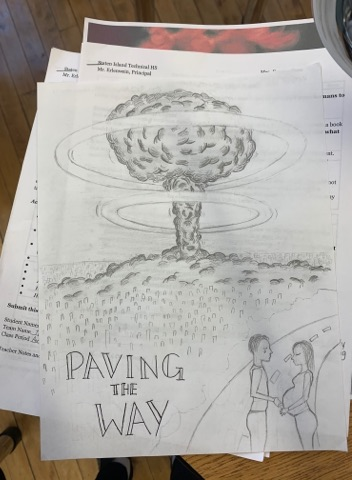
Paving the Way
Starting off the second presentation was Marlin who explained the backstory to their prequel. Their idea was that a nuclear war resulted in fallout and chaos due to the UN being unable to find peace. As a result, the world was divided and he described it as being similar to the Cold War. Paulo pointed out that there was evidence of ashes and bleakness in the book. In addition, the dad’s constant coughing out blood was a motif throughout the book. Daniel provided more evidence by explaining quotes from the book that would back up their theory of nuclear war. “The city was mostly burned… Cars in the streets caked with ash, everything covered with ash and dust.” “At night when he woke up coughing he’d sit up with his hand pushed over his head…”In the next slide, Mateusz talked about the various symbolism and concepts of their book cover. The black and white cover represented the duality of good and evil in their world. Grey represented the blend of good and evil, and how every action is both good and evil. Victoria talked about the fire pistol which was a symbol in the book. She talked about how fire pistols are usually used for emergencies in order to communicate when you're in danger, but the dad and boy fired the pistol for fun which showed a sign of lost hope. Towards the end, the group showed a clip of the aftermath of the bombing of Hiroshima to show the devastating effects of nuclear weapons.
31
The last group incorporated something no other group did: religion. Josh and Brendan explained that their title was an allusion to Christ’s birthday, which in turn was also the boy’s birthday. In their prequel, the boy is born on December 31st. They explained that by being born towards a new year, the boy represented hope/ a new start. Next, Adam did a recap of the book “What We Know From the Book”. He provides several quotes to support his points; the planet was devastated by an apocalyptic event, the planet turned greyscale, everything burnt, ash everywhere and the events of the book take place in America. Helen then discussed the plot of the sequel where the Yellowstone volcano erupts and causes ash into the air. With the sun being blocked there was no way of getting food and there was no warmth.

Friday, September 20, 2019
9/19/19 Anthony Cheng PD 7
9/19/19
Modern Mythology
Anthony Cheng PD 7
Aim: How can we use our knowledge of The Road to illustrate possible causes for the Apocalypse?
Today in class, groups presented their book cover projects and shared their ideas on what
caused the world to be like what it is in The Road.
The first group to present was the Shopping Cart Crusaders:
Taya explained how in an attempt to satisfy the world’s growing demand for fossil fuels,
scientists decided to drill deep into the Earth’s crust. She went on to compare the Earth to
a balloon, reasoning that drilling too deep into the Earth will cause it to explode. She continued
by saying that as a result of our drilling, massive explosions occurred throughout the world.
The resulting soot and smoke would then block out the sun causing the eternal winter seen
in the novel. Dejon then added that explosions weren’t the only consequence of the drilling.
Massive shifts in the tectonic plates would then cause devastating earthquakes, explaining why
the clocks stopped working in the novel. Alex then explained that the long shear of light seen
in the novel was actually volcanic lightning, a real life phenomenon where an electrical
discharge is caused by a volcanic eruption, rather than from an ordinary thunderstorm. Alex
revealed that the real cause for the apocalypse was not the Earth’s crust exploding or volcanoes,
the real cause was humanity’s greed. As a result of the never-ending greed of governments
across the world, the world was destroyed and rendered into the desolate wasteland seen in the
novel. Picking up from Alex, Allen explained the reasons for why humanity made the choices
that took place in the novel. He reasoned that since governments fell apart as a result of the apocalypse,
ruthless death cults were created to pick up what was left behind and people
were forced to join to survive. He then discussed the moral degradation of the world, with
things that were once seen as immoral now becoming necessity, such as cannibalism,
murder, stealing, and slaves. Kelly and Iandra then presented their group’s book cover and explained its deep symbolism
.

The novel’s name is a play on words of the song “Highway to Hell,” further emphasizing
the consequences of humanity’s greed. The hole drilled into the paper represents the drilling
into the Earth’s crust and The Boy is seen all alone. When opened, the cover reveals life before
and after the Apocalypse. Drills are seen in the background and the man possesses most of “the fire.”
The long shear of light in the middle represents the Apocalypse taking place and the open door
has a double meaning of either the bunker or the basement of slaves, illustrating how the new
world is full of uncertainty and something could easily be either a tranquil paradise or
just another depiction of how far humanity has fallen. On the right side of the poster, as The Boy and The Man continue to walk down the road, it becomes shattered and broken, similar to the world itself.As they progress, The Man gives The Boy all of “the fire” that he possesses and dies, forcing The Boy to continue on his journey to restore light in this bleak world alone.
The next group to present was Cloudy With a Chance of Meatballs:
Their presentation was a video and it began with an asteroid striking the Earth, devastating
it and knocking out electricity across the world. Volcanic activity then occurred as a result
of the asteroids striking the Earth and the ensuing smoke and sulfur would then block out the
sun, freezing the world. Despite all this, some remained hopeful that the government would
save them from what was to come. Unsurprisingly, the government failed and the world order
was destroyed. Cults were formed everywhere and murdered and cannibalized any survivors.
They reasoned that cannibalizing was a sign of mercy, releasing them from the cruel world they
live in. The group then explained the difference between The Man and The Boy and the road
agents, pointing out that despite all living in the same conditions, The Man and The Boy kept
their morals in a broken world and never devolved into savages.
The last group to present was my group Me and the Boys:
Billy started the presentation off by stating the name of our novel and relating the destruction
and death of the Normandy Landings to the events that take place before The Road. I then read a quote from our novel, “The world saw it coming. It was everywhere. The news, the media, and
the internet. But no one could stop it….. one day, it just exploded. The whole world turned dark within a matter of days. Ashes everywhere. The sky, the oceans, and the land,” and explained how
the world was reduced to its current state in The Road due to a supervolcano on a scale never seen before that devastated the world. The smoke and sulfur from the resulting eruption blocked out
the sun and caused the winter seen in the novel. Marcus presented our cover and explained how the figure in the back represents The Man witnessing the destruction of the world. The figure in the front represents The Boy and although he is not born yet, he represents the future the man has coming and his desire to protect him from the barbaric world.
Kevin explained the events that took place in our novel. He explained that a super volcano that was predicted to erupt every 17,000 years last erupted 74,000 years ago and was long overdue. Thought to have remained dormant, no one expected it to suddenly erupt. The world that everyone knew was about to change. On the Friday of September 13th, a huge eruption shook the Earth. Ryan picked up from Kevin and said that most died nearly instantly. Eruptions continued over the span of a few months causing unimaginable damage to the world before it had finally stopped. By the time the eruptions stopped, the world was completely dark, covered with ashes and fumes spread by the wind. Terrance talked about the consequences of the disaster and included drastic temperature drops due to the sun being blocked out by all the smoke and sulfur and the resulting extinction of several plants and animal species.Water became polluted and food supplies dwindled as the world fell apart and society crumbled away. Billy then revealed how humans were affected by the disaster and talked about how many turned to cannibalism in order to stay alive as a result of the lack of food, trading their humanity for survival. 
Student Reflection:
All in all, every group did a great job and it was interesting to see the various causes we came up with. A big takeaway from the presentations is our tendency to take the Earth for granted and not making enough of an effort to preserve it. Although The Road is a work of fiction, serious problems like global warming, pollution, and deforestation are not. The groups cited grand causes for the destruction of the world, such as supervolcanoes or gigantic asteroids. However, if we replace those with the very real harmful activities that we perform on a daily basis, it seems as if humanity doesn’t need an outside force to destroy our world, we are already slowly doing it ourselves. What the presentations have taught me is that we only have one world, we must make a greater effort to preserve it or fiction will become reality.
Thursday, September 19, 2019
9/19/19 David Gao|These prequels are hoT HOT HOT|
9/19/19
David Gao
PD 4
Aim: Take notes and reflect on our classmates' Fahrenheit 451 prequels
So today our classmates were presenting their Fahrenheit 451 prequel covers and three groups went today then we gave feedback about what we liked and maybe things that hey could've improved on afterwards.
Devils in Suits
End of the Road
David Gao
PD 4
Aim: Take notes and reflect on our classmates' Fahrenheit 451 prequels
So today our classmates were presenting their Fahrenheit 451 prequel covers and three groups went today then we gave feedback about what we liked and maybe things that hey could've improved on afterwards.
Devils in Suits
- Their cover showed a city encased in bubbles and another city and also people in suits.
- They said that their cover was called Devils in Suits because government people usually wear formal attire like suits and so they were describing the government as devils because of the way that they limited speech and are controlling the people.
- This group talked about how the life that the government created is so superficial and dull that some people would rather die than live.
- First we discovered Montag's wife, Mildred in bed after chugging a bottle of sleeping pills and after Guy calls the guys to come over and suck the drugs out of her we learn that suicide is a common occurrence, so common in fact that they had a machine built and they had just gotten another call for help. This shows that being unhappy is just another thing that happens and if it happens, just call the guys with the sucky machine and it's all over and everything is good, almost as if it were the norm.
- The second suicide, by the woman in the fire with her books, goes to show that without her books she sees no point in living, and that she'd rather burn with them than give in to the government's ways of living their ideal life.
- The last one is not a suicide but Beatty was basically asking for it, literally, as he told Montag to pull the trigger and that's after he threatened his friend, so if that's not asking for death I don't know what is. This is basically Beatty seeing a chance to quit his empty life and so instead of running from death he stands in front of it and faces it head on.
End of the Road
- Their covered showed a sort of distant government building with a hand in front of it and strings coming out of the hands and people in groups that were labeled: Little black sambo, Uncle Tom's cabin, and smokers.
- Their group talked about how society was at a standstill because everyone disagrees with one another and challenging other's ideas. This leads to nothing ever getting done as they are just fighting among themselves.
- The hands in front of the government building showed that the government is sort of puppeteering them to fight each other.
- They also said that it could also be started by the people but the government decided that the fighting was beneficial for them so they didn't do anything to stop it.
- The people fighting out in front with their groups represent how everyone disagrees with each other and also is a visual for this quote “Coloured people don't like Little Black Sambo. Burn it. White people don't feel good about Uncle Tom's Cabin. Burn it. Someone's written a book on tobacco and cancer of the lungs? The cigarette people are weeping? Burn the book.”
- The three groups represent the three groups in this quote and also how this is what society is doing instead of working together and not realizing that this is exactly what the government wants them to do.
- This group also expanded by explaining that by manipulating the people in this way allowed them to control their society easier because now nobody has the intelligence to think differently and challenge them.
- To add on, people who read books were also more intelligent than those who didn't which made them sort of inferior and could have turned the majority onto the minority of people who were studious which could be a factor in the start of their "debates".
Overall I think this group did very well and in illustrating their points as the cover was sort of chaotic to show the state of the people and how the government was manipulating them without them really realizing, which was illustrated very well. Also their examples and quotes were really strong to support their argument.
Before the burn- This group's cover showed someone standing in the middle with their face blurred out and two things by its side which the middle person is controlling.
- The blurred out person shows that the cause of the hatred for books is sort of unknown because it could have been the people that just decided that books were bad because they all disagreed with each other and hated on the ideas of some books.
- The burred person could also represent the government to limit creativity and intelligence.
- This group talked about how if the government were behind the books then they could have slowly encouraged people to read less and less which would mean that nobody would think in different ways and create controversy which could endanger their version of an utopia.
- The group uses this quote by Captain Beatty "Forget them. Burn them all. Fire is bright and fire is clean." to support their argument that the government is manipulating them in some way as so many people think the same way Beatty here and just likes to incinerate their problems and leave them to burn away into nothing instead of dealing with the past.
- These arguments lead to the groups prequel idea that the children born are mostly all geneticlly modified to fit the government's view of a perfect society, an ideal generation
- They backed this up by explaining how disconnected the parents seem from their children almost as if they don't really care about them and were possibly requierd to have them so the government can construct its ideal generation.
- They also provided more evidence in the form of this quote "You can't rid yourselves of all the odd ducks in just a few years. The home environment can undo a lot you try to do at school. That's why we've lowered the kindergarten age year after year until now we're almost snatching them from the cradle" which shows that the government could be trying their best to completely control these children to their ideals so much so that one mother doesn't see her children 9/10 days, although it likely because she's so disconnected form her children that its's that way.
- Then they went on to explain how some people might not choose to genetically modify their children which could lead to "queer" that think differently because they are influenced more by their parents than the school system.
- They use this to explain how these kinds of children are a threat to their ideal society because they think differently and can influence those around them to challenge what they think as well.
- I think that this also ties into why the government is keeping track of these people in case they do something like influence others they can immediately eliminate them
- Another example of a "queer one" could be the man who was "Montag" walking outside, as he was different from everyone else as well and they kept tabs on him in case he were to influence others.
I think that overall their arguments were also very good and honestly I'm almost convinced that this could be what actually happened because it explains so much and the evidence to back it up and the way people act in the book just seem very on point with their argument.
Final Words:
I think that all three groups presented very good prequel arguments and their covers were all very symbolic. Their arguments also all were very plausible and all had a similar theme of either the government or the people being the cause of the limitation of speech and free thought, and all were similar in that the government definitely was in some way manipulating the people to get what they wanted, which is what's really important here because the government abused their power in a corrupt way to override and bypass the rights of the people in some way without the people even realizing that things are as bad as they are. Finally I think that there was an underlying theme of a empty life in all three groups, in Devils in Suits they talk about how people often commit suicide because they are that unhappy with their lives, which is a common occurrence. In End of the Road the theme is present in how society is at a standstill because everyone's arguments are empty and seem to just be arguments for the sake of arguing because they disagree with the very topic of their point without ever thinking about their perspective and focusing solely on being in the right and having that "right" being your group of people. In Before the Burn the emptiness is shown in how disconnected from everyone, everybody is because mothers don't care about their children and Mildred doesn't care about Montag and nobody cares about the books and the people but instead are just focused solely on entertainment that's right there, their "family".
Emma Cheung Blog #1 - 9/19/19 Period 2
Project Presentations Day 1
1) The Mineshaft
-argument over name: decided on Road Work Ahead (Wall-E reference I think)
-greyscale except boy and father: everything grim and bleak, reflects setting of book
-simple to be able to show what is going on but not enough to give the feeling of wholeness --> emptiness and hopelessness
-plot: company (Biolarge? I am uncertain of the spelling) tries to trash earth, literally. They tried to ship ppl out to space, and a spaceship crashes. The man and the father were on it.
-well done overall, interesting plot idea / interpretation of data and lots of textual evidence. Personally not big on the cover, but it does the job.
2) The Roadkill
-lots of symbolism in the imagery (city, meteorite looks like smiling face in the sky, house is isolation)
-good textual evidence to back up their claims
-plot not as interesting as the Mineshaft's, but the idea of zealous arsonists worshiping the the meteor and its fire is realistic and adds and interesting edge to their story... (plus cannibalistic cults).
-bit long, went over 10 min
-I really, really love how they went into how the fires came to be and the role religion plays in a post-apocalyptic world. It expands on what little McCarthy has given us in a way that so seamlessly connects points I didn't think could be related. Great job.
3) Going South
-simple, concise cover. Not much symbolism, references the book closely with the stopped clock.
-asteroids, parallels to extinction of dinosaurs. no flora or fauna, dust and debris (potentially why the father is coughing), darkness, colder climate
-great elaboration on the selfishness and cruelty of desperate people and how utilitarian everything has become
-feels a tad bit boring compared to the other two, but it's still quite good on its own. It doesn't have that creative flare the other two did, but the seriousness and the stress on human values in such a situation I think closes off the presentations nicely. After the more wild and fantastical ideas the Mineshaft and the Roadkill gave us, this felt like it was bringing us back to the more philosophical core of the book.
Subscribe to:
Posts (Atom)